

Stellar Consulting - MEA · 10,367 followers
March 10, 2026
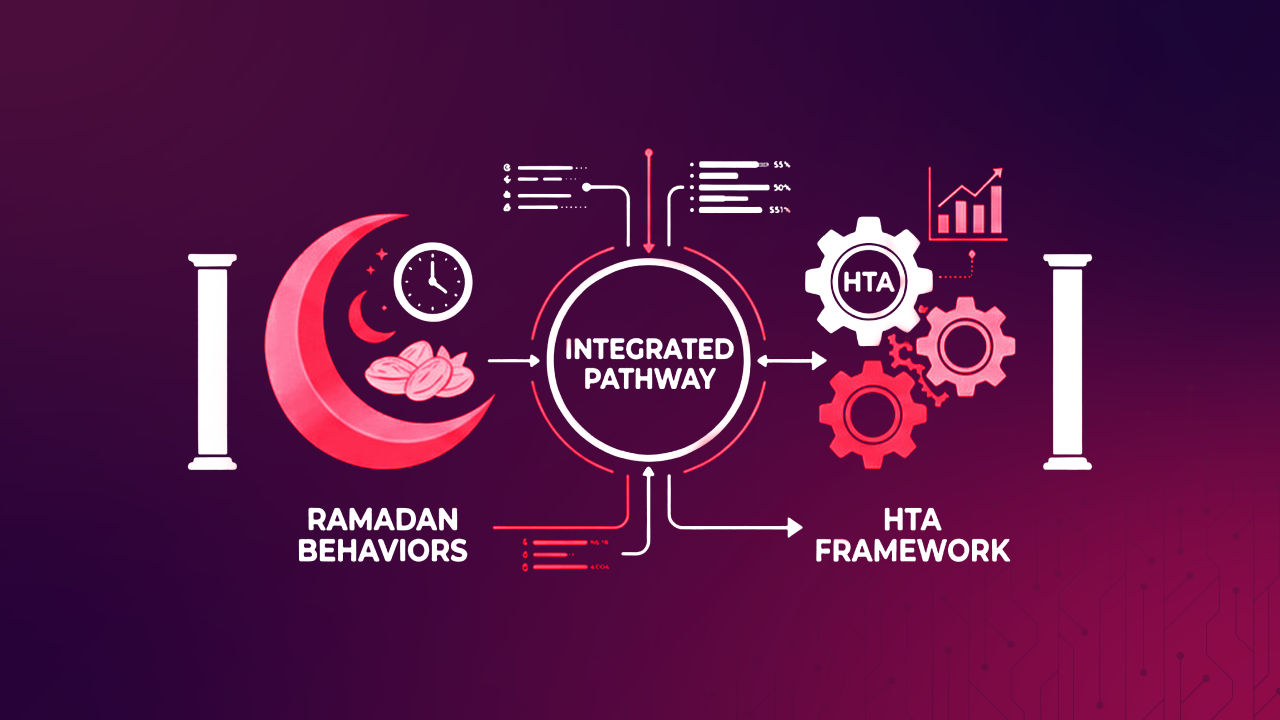
Health Technology Assessment (HTA) is an evidence-based framework for evaluating clinical effectiveness, cost-effectiveness, and overall impact of health interventions to inform policy and resource allocation decisions. It integrates clinical data, epidemiology, economic evaluation, and health system considerations. Core methods—such as comparative effectiveness assessment, cost-utility analysis, and budget impact modelling—are internationally established and underpin national HTA systems globally (1,2). Ramadan, the ninth month of the Islamic lunar calendar, is observed by approximately 1.7 billion Muslims worldwide through daily fasting from dawn to sunset. Fasting during Ramadan induces substantial physiological, behavioral, and social modifications, including altered meal timing (iftar and suhoor), disrupted circadian rhythm, reduced daytime physical activity, changes in sleep architecture, and modifications in medication schedules among patients with chronic diseases (3,4).
1. These behavioral adaptations may significantly influence:
Clinical outcomes
Medication adherence
Acute complication rates
Healthcare utilization patterns
Such changes are particularly relevant for chronic conditions including diabetes mellitus, hypertension, and cardiovascular diseases (5,6).
2. Clinical Impact Domain
2.1 Glycemic Control and Acute Complications
Evidence demonstrates that Ramadan fasting is associated with:
- Increased risk of severe hypoglycemia
- Increased risk of hyperglycemia
- Altered glycemic variability
- Increased diabetes-related emergency visits
The landmark EPIDIAR study across 13 Muslim-majority countries showed a significant increase in severe hypoglycemic events during Ramadan among patients with diabetes (5). Subsequent international guidelines confirmed elevated metabolic risk among high-risk diabetic patients who fast (6).
2.2 Cardiovascular and Metabolic Effects
Studies evaluating cardiovascular outcomes during Ramadan suggest potential fluctuations in:
- Acute coronary events
- Blood pressure control
- Fluid balance
Additionally, lifestyle alterations during Ramadan influence:
- Body composition
- Sleep quality
- Mental health parameters
These factors may indirectly affect chronic disease stability and complication risk (3,4,7).
3. Health System & Utilization Domain
Ramadan is associated with observable healthcare system shifts:
- Reduced daytime outpatient visits
- Increased nighttime healthcare utilization
- Changes in pharmacy refill patterns
- Variation in emergency department admissions
Such seasonal variation introduces structural deviations from the steady-state assumptions typically embedded in HTA economic models (5,8).
4. Implications for HTA Methodology
Traditional HTA frameworks assume:
- Stable adherence patterns
- Constant event probabilities
- Uniform healthcare utilization across the year
However, Ramadan introduces a time-dependent behavioral modifier that may alter:
- Clinical effectiveness estimates
- Event probabilities (e.g., hypoglycemia rates)
- Resource utilization parameters
- Cost inputs
- Utility values (HRQoL fluctuations)
Failure to incorporate Ramadan-adjusted parameters may bias:
- Incremental Cost-Effectiveness Ratios (ICERs)
- Budget Impact Analyses (BIA)
- Reimbursement decisions
5. Proposed Ramadan-Sensitive HTA Adaptation Model
A. Clinical Effectiveness Layer
Subgroup analysis: Ramadan vs. non-Ramadan periods
Risk stratification by fasting status
Adjustment of event probabilities during fasting month
B. Economic Evaluation Layer
Seasonal adherence correction factor
Ramadan-specific complication rate modifier
Short-term cost surge parameter (acute events)
Utility adjustment for sleep and lifestyle disruption
C. Real-World Evidence Layer
Pre–post Ramadan observational cohorts
Claims-based utilization comparison
Prospective adherence monitoring
6. Policy Relevance for Muslim-Majority Settings
In MENA health systems, Ramadan represents approximately 8–9% of the annual calendar yet may disproportionately influence:
- Acute complication burden
- Short-term hospitalization costs
- Medication adherence
- Healthcare system workload
Integrating Ramadan-sensitive adjustments into HTA submissions would enhance contextual validity, improve reimbursement precision, and ensure culturally responsive health policy decision-making.
References
(1) Drummond, M. F., Schwartz, J. S., Jönsson, B., Luce, B. R., Neumann, P. J., Siebert, U., & Sullivan, S. D. (2008). Key principles for the improved conduct of health technology assessments for resource allocation decisions. International journal of technology assessment in health care, 24(3), 244–368. https://doi.org/10.1017/S0266462308080343
(2) O'Rourke, B., Oortwijn, W., Schuller, T., & International Joint Task Group (2020). The new definition of health technology assessment: A milestone in international collaboration. International journal of technology assessment in health care, 36(3), 187–190. https://doi.org/10.1017/S0266462320000215
(3) Trepanowski, J. F., & Bloomer, R. J. (2010). The impact of religious fasting on human health. Nutrition journal, 9, 57. https://doi.org/10.1186/1475-2891-9-57
(4) Roky, R., Chapotot, F., Hakkou, F., Benchekroun, M. T., & Buguet, A. (2001). Sleep during Ramadan intermittent fasting. Journal of sleep research, 10(4), 319–327. https://doi.org/10.1046/j.1365-2869.2001.00269.x
(5) Salti, I., Bénard, E., Detournay, B., Bianchi-Biscay, M., Le Brigand, C., Voinet, C., Jabbar, A., & EPIDIAR study group (2004). A population-based study of diabetes and its characteristics during the fasting month of Ramadan in 13 countries: results of the epidemiology of diabetes and Ramadan 1422/2001 (EPIDIAR) study. Diabetes care, 27(10), 2306–2311. https://doi.org/10.2337/diacare.27.10.2306
(6) Hassanein, M., Al-Arouj, M., Hamdy, O., Bebakar, W. M. W., Jabbar, A., Al-Madani, A., Hanif, W., Lessan, N., Basit, A., Tayeb, K., Omar, M., Abdallah, K., Al Twaim, A., Buyukbese, M. A., El-Sayed, A. A., Ben-Nakhi, A., & International Diabetes Federation (IDF), in collaboration with the Diabetes and Ramadan (DAR) International Alliance (2017). Diabetes and Ramadan: Practical guidelines. Diabetes research and clinical practice, 126, 303–316. https://doi.org/10.1016/j.diabres.2017.03.003
(7) Temizhan, A., Dönderici, O., Ouz, D., & Demirbas, B. (1999). Is there any effect of Ramadan fasting on acute coronary heart disease events? International journal of cardiology, 70(2), 149–153. https://doi.org/10.1016/s0167-5273(99)00082-0
(8) Sulimani, R. A., Famuyiwa, F. O., & Laajam, M. A. (1988). Diabetes mellitus and Ramadan fasting: the need for a critical appraisal. Diabetic medicine, 5(6), 589–591. https://doi.org/10.1111/j.1464-5491.1988.tb01057.x